
From historic homes to neighborhood bakeries, Scituate’s Country Way is one of the South Shore’s most beloved back roads.
Written by Richard Trust Photography by Zoe Stoner
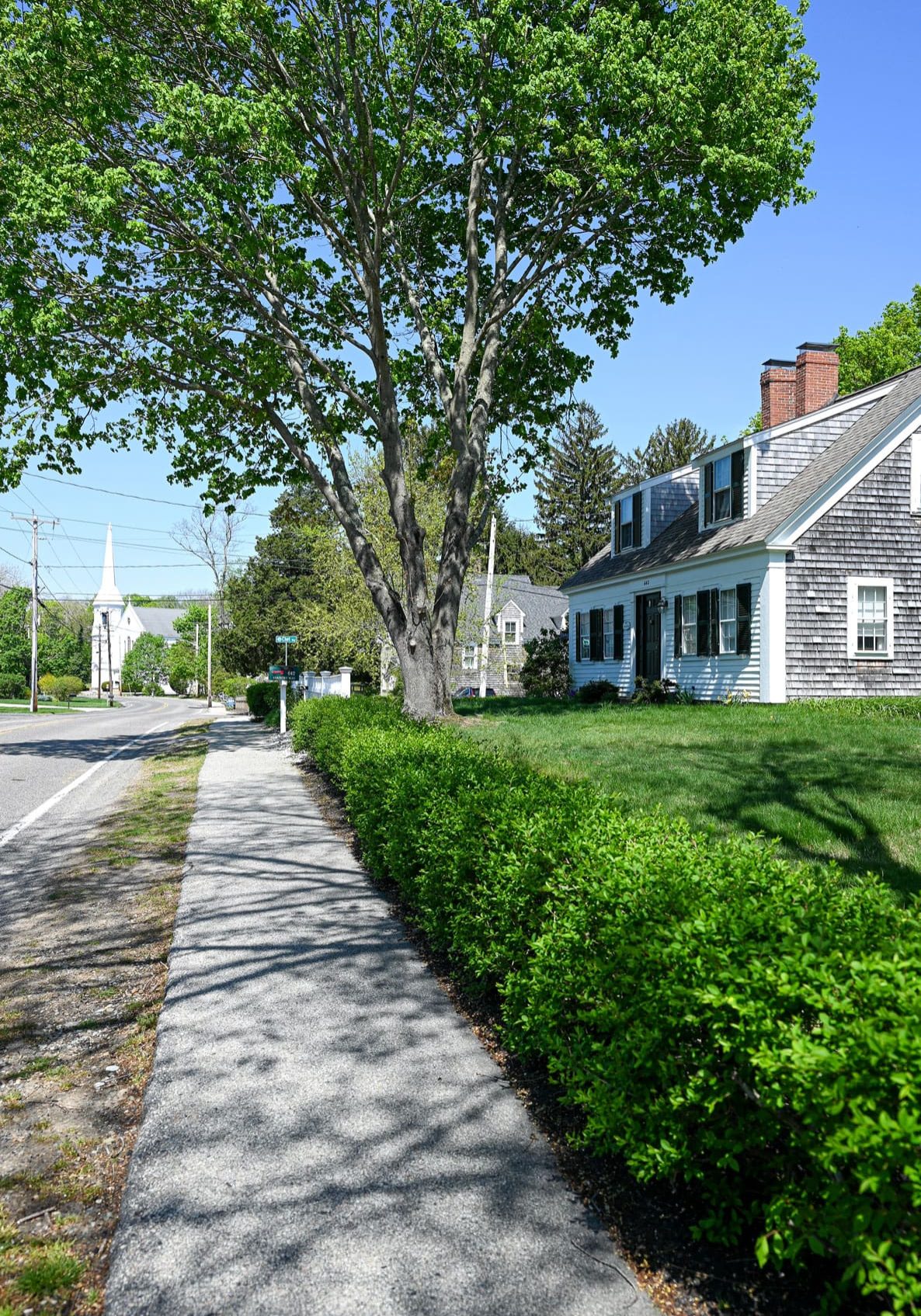
Long before Routes 3 or 3A existed, Country Way was king of the roads in Scituate. The region was first settled by Europeans in the 1620s. The earliest mention of a “country” road came about in 1646, when according to a passage in town archives, a local byway came to be known as “the Country Road.”
“There were practically no laid out or named roads or highways, only footpaths and cartways, which ran from house to house or some central point,” wrote Charles C. Lincoln in Old Roads of Scituate, 1950-51.
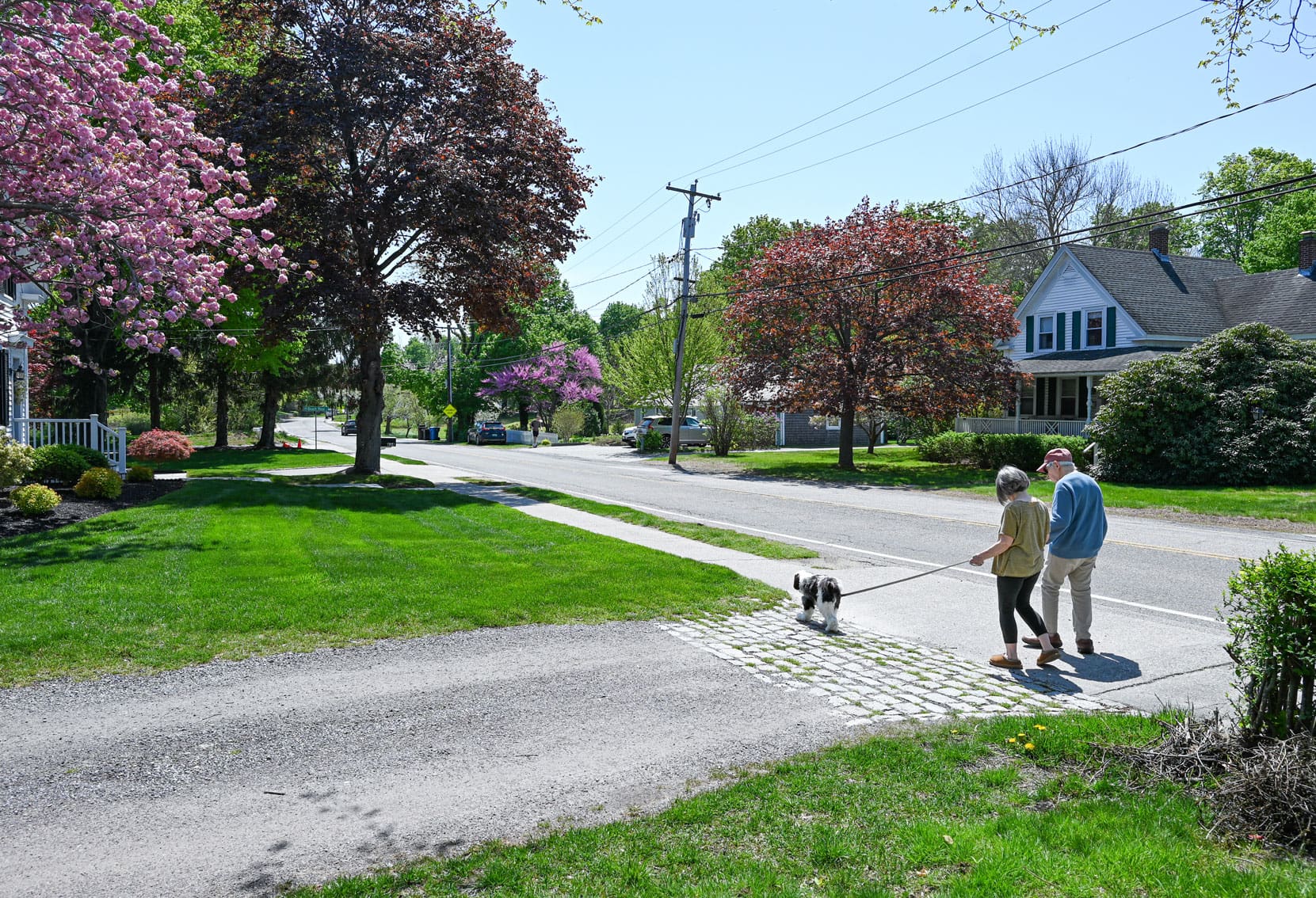
Today, Country Way stretches 4.27 miles, from the border of Cohasset to the Scituate neighborhood of Greenbush. The road winds past an assortment of historic homes, landmark buildings, local businesses, and iconic stone walls. Sidewalks make the road popular with walkers, joggers, serious runners, parents pushing baby carriages, bicyclists, and countless people walking dogs. No other street in Scituate has such a unique combination of volume and variety of pedestrian traffic as Country Way.
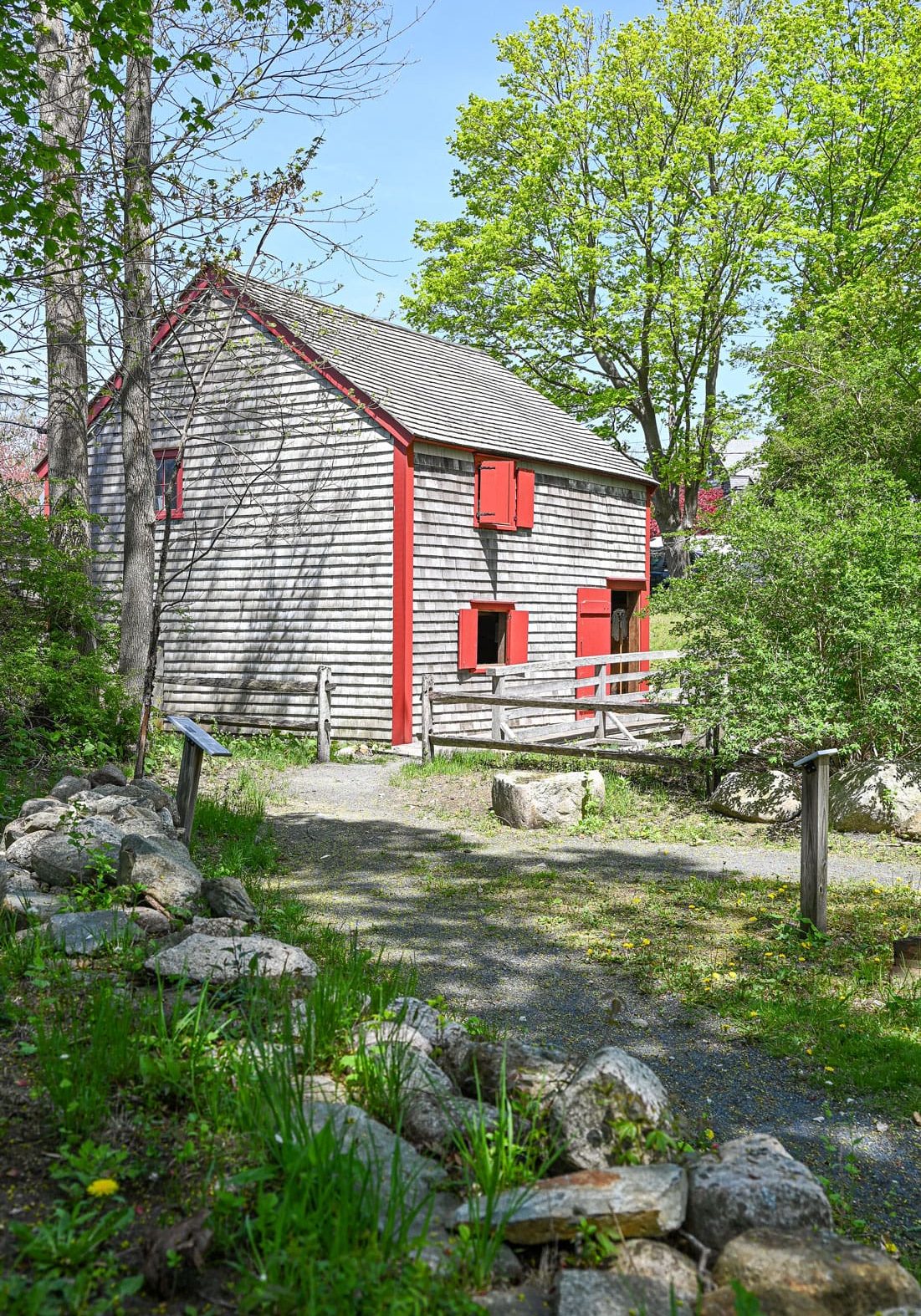
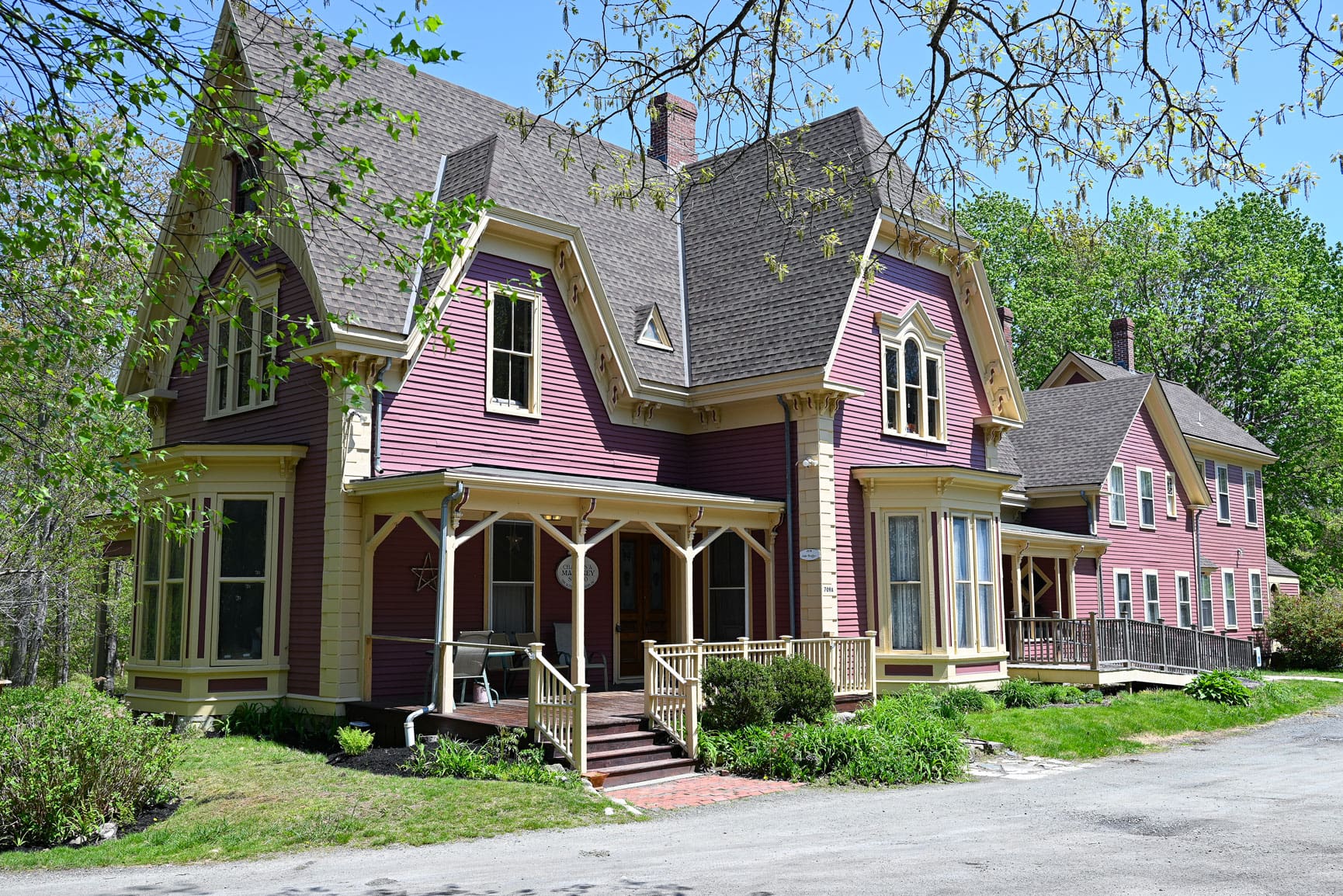
The antiquity of the homes located along Country Way adds to its character. The majority of domestic dwellings were constructed no later than 1950. The oldest structure on the road is the Stockbridge Mill, built circa 1640.
“I like looking at the historic houses,” says Eleanor (Elly) Kern, a Scituate resident who walks close to two miles every other day with Bear, her six-year-old Jack Russell Terrier. “So many of the names [on the historic house plaques] are familiar.”
In summertime, tall oaks, maples and flowering trees provide a green canopy over the sidewalks and in autumn the landscape transforms with splashes of red, yellow and orange. There’s no need to go elsewhere for fall foliage. All the leaf peeping you’ll ever need is right on Country Way.
You have to get up early in the morning to beat Davina Perl out to Country Way. A painter of fine art, she sees her surroundings at sunrise through an artist’s eye while keeping company with Moxie, her three-year-old female mini-dachshund – all eight pounds of her.
“I love walking Country Way in the morning,” says Perl, who lives on a side street maybe a hundred yards from her chosen route. “When I’m headed toward North Scituate Village just as the sun is waking up, I can see it making the First Baptist Church steeple this beautiful shade of pink.”
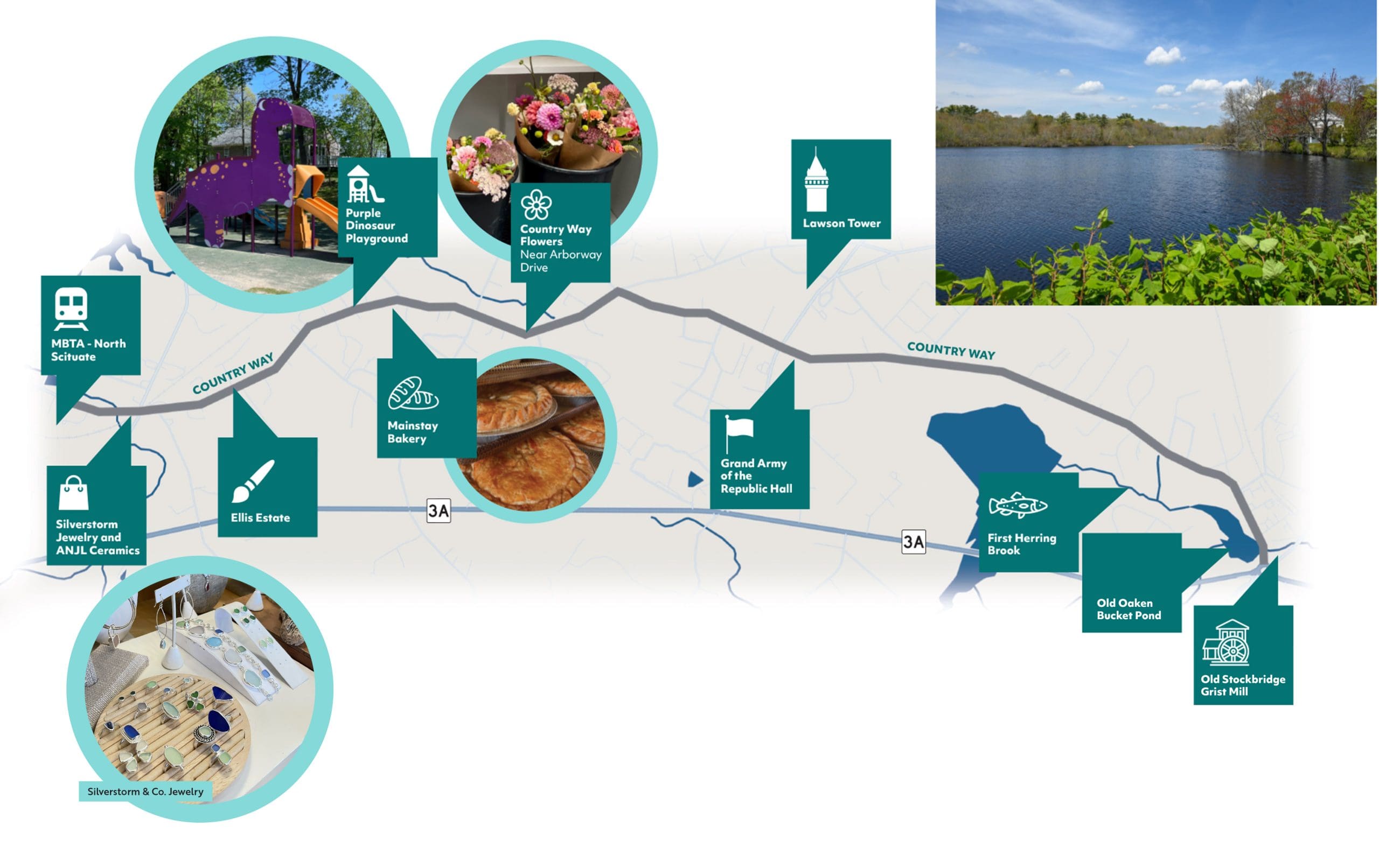
Perl reserves two days a week for short strolls to Mainstay Bakery, which operates out of a barn at 599 Country Way. There, she picks up her weekly stash of freshly baked bread, cookies, truffled cashews, and parmesan crisps. When the weather is agreeable and her painting schedule cries out for a break, she occasionally chooses to set down her brushes and go on a three-mile run.

“I also love Country Way because my little dog’s best friend, Scout (a three-year-old Tibetan Terrier), lives there,” says Perl. “They love playing together.”
Tom Wall, a retired house painter, and his wife, Carol, a retired Scituate High School English teacher, also enjoy walking down Country Way. They usually start their walk a short distance from their home on Mann Lot Road and then head for the Purple Dinosaur Playground before turning back and walking up Studley Royal to Groveland Cemetery. There, they pause and visit the gravesite of Levi Newcomb, the first occupant of the Walls’ Cape-style home that was built in 1827.
“There are good sidewalks to walk on, and there aren’t a whole lot of sidewalks in town,” says Tom. “It’s a nice, flat walk and it gives us something to do when we aren’t playing golf.”
For residents like Robbin Mangano, a publicist and business manager with two young children, being able to easily maneuver a stroller down the sidewalk is important.
“That’s one of the big reasons we moved here,” says Mangano. “We used to live in another area of town where there were no sidewalks. Sometimes it didn’t feel safe walking, especially when it was closer to night time, or when people were speeding.”
Mangano also admires the beauty of the landscape, which comes alive in summertime with gardens of multi-colored wildflowers and tall sunflowers. Speaking of flowers, summer is when beautiful zinnias, peonies and dahlias are blooming at Country Way Flowers. This neighborhood flower cart is a bit of a hidden gem known only by locals. If you send owner Michelle a message on Instagram she will send you the address.
Jackie Rioles, a Scituate resident for the last 11 years, enjoys walking Country Way from Hollett Street up to the North Scituate Greenbush commuter rail station. “It’s a nice area with beautiful homes to look at,” says Rioles. “Walking clears my mind and it’s great exercise. It’s my after-work release.”
The part of town known as North Scituate Village is home to a variety of local artists and businesses. Silverstorm & Co. Jewelry and Good Roots Boutique share a sunny space inside one of the town’s historic buildings located beside the train tracks. Just around the corner is ANJL Ceramics, a full-service pottery studio filled with handcrafted bowls and mugs.
Francis M. Litchfield is remembered as Scituate’s last Civil War veteran. When he died in 1936 at age 91, the Women’s Relief Corps and the Sons of Union Veterans assumed management of what had become the Grand Army of the Republic Hall. Located at 353 Country Way, the GAR Hall dates to 1825, when the Baptist Society contracted with Zeba Cushing to build a meeting house on land purchased from Nehimiah Curtis.
Fronted by its iconic Civil War-era cannon, the town’s oldest public building has undergone many transformations but at its core, it honors those who fought in the Civil War (1861-65). The Baptists outgrew their old meeting house and by 1870 had relocated to what is now the First Baptist Church at 656 Country Way.
The Scituate Historical Society bought the GAR Hall from the town of Scituate in 1997 and with the help of Community Preservation Act funding, it took six years for the Grand Army of the Republic to be renovated into the exquisite meeting hall it is today. The building now offers lectures, presentations, and exhibits, and is also available for private rentals.
Scituate has no roadway named Main Street, but given the activity on Country Way, the folks who live on that 4.27-mile stretch just might feel that their thoroughfare is the main street in town. Who’s to say otherwise?